R&D Tax relief for Sex Tech. Do you qualify?

Growth in Research & Development (R&D) tax relief claims totalled over £4bn last year. Introduced by the Government in 2001, the purpose of R&D tax relief is to offer tax credit benefits to those businesses who develop scientific and technological innovation across many industry sectors here in the UK. Reportedly to date, £26bn has been returned in tax relief to businesses across the nation and yet according to industry specialists the scheme is yet to be fully utilised.

Were you aware that Sex Tech is a key area where R&D claims are currently not being taken advantage of?

Without a doubt, Sex Tech is consistently producing pioneering work that would easily qualify under the R&D tax relief framework. Whether it is a new technology, stimulation technique, material or even the way these products are made, any and all new advancements tend to be leading innovation in the sector.
Presently the amount of Sex Tech companies applying for R&D is staggering low. This leads us to ask, is that because Sex Tech is either ignored or seen as too much of a taboo? Or is the onus on companies like you who might not even realise that you qualify?

In short, any UK limited company that is spending money on developing new products, or enhancing existing ones is eligible. Even if you’re not sure if your new product is possible, or you don’t know how to achieve it in practice, you could be resolving technological uncertainties and therefore be carrying out qualifying R&D.

The important thing to remember is that the Government’s accepted R&D definition doesn’t have to have been successful to qualify. If your project is ultimately unsuccessful but sought a solution, it could still be R&D. It is worth asking your accountant to look into this for you but you can also look for advice from HMRC and specialist tax advisers if your accountant is not 100% certain.

For more about R&D Relief click here.

If you’ve got an idea you want to take to market, we will assist you through your journey. Our services can include trend spotting and feasibility of a new adult toy product, ergonomic studies and reverse engineering which could all be attributed to R&D. Although we do not fund projects here at Sated Design, we have a comprehensive directory of business angels and companies who regularly invest in new businesses who wish to develop their products.

Contact us today and learn more about our services and how we can help.

Sharing

FacebooktwitterredditpinterestlinkedinmailFacebooktwitterredditpinterestlinkedinmail

Consumers are calling for an Eco Friendly sex life

The causes of climate change are a consideration for New Product Design and Development in every industry. Seemingly one industry that needs to pay attention is the adult toy industry. The majority of adult toys are made with polymers and many use disposable batteries. Most importantly, consumers can’t (or don’t want to?) easily recycle an adult toy and so they sit in drawers for years before discretely going into landfill wrapped against inquisitive eyes. All of which contributes towards the 45 million metric tonnes of electronic waste the world produces every year.

In actual fact adult toys made from sustainable materials such as wood and glass have been in the marketplace for many years. It is fair to say that adult toys made of wood and stone predate history. If the climate goes the way many are predicting your next adult toy might just have to be carved out of a bit of wood as you sit in a cave! To avert that, an increasing number of consumers are making an effort to prevent more damage to our planet by demanding environmentally friendly products.

The adult toy industry has seen a huge growth in recent years as adult toys become more widely acknowledged as products contributing to health and well-being. In the press recently has come news that large retailers such as Sainsburys and Boots are now stocking a number of “top shelf” adult toys. At the same time, consumers are demanding ethically manufactured products. We at Sated Design therefore expect to see the adult toy market shift towards a more ethical manufacturing base and we predict new companies will come into the marketplace to exploit their know how in those areas and capitalise on the opportunity. Established manufacturers need to make sure they are not caught napping.

Consumers will demand provenance for claims made about any products that claim to be eco-friendly and ethically manufactured. Allied to this will be consumer expectation that products must still deliver the highest quality and performance. We think these will be challenging times especially when social media picks its heroes and its villains.

Do you have an idea for a new Sex Toy? Would you like a little help to guide you through the journey of making your product a desirable reality? Get in touch today – we may just be able to help you.

Sharing

FacebooktwitterredditpinterestlinkedinmailFacebooktwitterredditpinterestlinkedinmail

The Importance of Continuous Testing

Testing a product concept during all stages of its development is an important part of the design process. Prototypes, mock-ups and test rigs, or whatever you wish to call them, enable the design team to evaluate every aspect of a product. Using feedback derived from tests the design team create great products which delight the user and make healthy profits for the manufacturing and distributing chain.

Here at Sated Design our approach to the development of adult toys makes use of many different types of prototypes and each prototype brings its own benefits to the end design. At the end of the development process the design team and the client can be confident that the final product is indeed fit for purpose. Prototypes are generally made in house in our model shop although we will use external suppliers for specialist parts.

Good visual imagery is an important part of any design process as it is an effective way of showing what the final outcome will potentially look like. 2D images have their place; they are great for visualisation but are unable to portray some of the important details; for example the weight and feel of the product. Accurate prototypes that are faithful to the intended appearance and feel of the final design are extremely useful in marketing discussions and for pre-launch media. We have lost count of the number of occasions when a prototype has been photographed before a production piece has been available. That is not poor time planning, it is in fact the opposite and a necessity when rapid design techniques have to bring together marketing/promotion during the run up to a launch or exhibition.

Good user experience is a vital part of any adult toy. The whole experience of receiving the item, opening the packaging and switching the toy on are very important but they are the aperitif for the main course. If the toy does not ‘work’ then it is just a big let-down and that has to be avoided at all costs. Working prototypes are a vital part of getting this right in the product development. An example of how this process can work came about very recently when our model makers made a silicone prototype of a new vibrator. This was sent out for user testing and the feedback suggested that the sensations could be improved by thickening a certain part of the shaft profile. A second prototype was quickly prepared and once again sent out to the same person for testing. Within days we received positive feedback. This simple, quick and low costs exercise gave the client the confidence to immediately go forward to the next stage of development and the tester kept the prototype!

Some prototypes are quite mundane but they still serve a vital role in improving the assembly and cost effective manufacture of a product. It is not uncommon for our design team to prepare several 3D printed prototypes to evaluate wiring, motor mounting, jigging/fixtures and resolving fine details of switches and connectors to ensure that no detail is ignored.

Do you have an idea for a new Sex Toy? Would you like a little help to guide you through the journey of making your product a desirable reality? Get in touch today – we may just be able to help you.

Sharing

FacebooktwitterredditpinterestlinkedinmailFacebooktwitterredditpinterestlinkedinmail

What happens to E-Waste?

Electronic products are all around us today. In fact if you’re reading this article then you’re looking at one right now. But what happens when these products reach the end of their life, or are made obsolete by newer tech? This is a question with two outcomes, good news and bad news. We would all agree that we absolutely must do something to deal with E-Waste. The bad news is that the results of that process often cause damage we do not see or choose to ignore. The way we deal with our E-Waste must be something we are all made aware of so we really understand the true cost of that new smart phone or TV.

Products like smart phones, IT equipment and home appliances are advancing so rapidly in their capabilities that they become redundant within months of their launch. Many homes and businesses are disposing of old tech products and the question is what can be done with these container loads of E-Waste?

E-Waste contains many valuable materials which can be recovered, such as gold, silver, copper, tin and palladium. The process for recycling electronic goods is similar to other more general recycling processes, following a path of collection, transportation, sorting and separation. Waste is collected and sent to a processing plant where items are manually sorted and disassembled, with parts like batteries removed and sent to specialist facilities.

Items that can’t be dismantled efficiently are shredded into smaller pieces and then spread out on conveyor belts using a shaking process. A high power magnet then sorts out the ferrous metals and further mechanical processes separate the metals from non-metals. A water separation process then divides the remaining plastic and glass materials.

Glass from cathode ray tubes (CRTs) commonly found in televisions and monitors contain more hazardous materials like lead, barium and phosphor. Processing these items is more complex, with extra washing and sorting steps to remove oxides and phosphors and to separate leaded and non-leaded glass.

Smelting is used to recover metals like gold, silver, tin and copper from PCBs and nickel, steel, cadmium and cobalt from batteries.

This is the good news part of the story because it results in a reasonable percentage of resources recovered. The bad news is that the predicted 50 million metric tons of E-Waste produced this year alone will create a big problem despite much of it being capable of being repaired or reused. The majority of it ends up in landfill or is incinerated, E-Waste is often legally and illegally exported to countries like China, India and Nigeria due to absence of more rigorous regulation. Once there, toxic materials like lead, arsenic and mercury leach into the water course, soil and air to become a huge long term problem in the environment affecting plants, animals and humans. The residents of Guiyu in China (an area known for recycling E-Waste) have the highest reported level of lead and dioxin found in people globally.

Out of sight and out of mind is not the way to deal with this problem. There is no easy answer but the majority of us are buyers of electronic products and we need to demand products that are easier to recycle and made with reclaimed material. Only then will product designers, not accountants get to set the design brief for how products should end their life.

Sharing

FacebooktwitterredditpinterestlinkedinmailFacebooktwitterredditpinterestlinkedinmail

Are There Advantages of Outsourcing Your Design Requirements?

Here we look at why it may be the better option rather than building your own in-house team of designers.

Experience:
Consultancies deal with a wide range of products across a variety of markets, giving them a greater breadth and depth of skill and knowledge. This knowledge helps to fast track ideas to becoming a reality, whereas working within your own confines can potentially take much longer, especially if it is proving difficult to know where to begin.

Working with many projects and different clients, here at Sated Design we can cross pollinate insights and knowledge gained from a host of different varying projects. Our depth of experience coupled with your knowledge results in original thoughts which develop into original products that standout not just in terms of aesthetics but also in functionality.

Cost:
Hiring external design services at first glance may seem expensive, but in the long run will prove to be cost effective. By paying for design services only when you need them, this not only saves on the cost of salaries but also all of the other extra expenses such as software-licences, workstations, prototypes and testing equipment.

Design consultancies not only help to save time and money by designing your product but also help you save when it comes to manufacturing. By using your design-house’s suppliers, you will be able to receive competitive quotations and manufacturing experience, which is not easy to find on your own.

Flexibility:
Designing might not be your full time job, it may be your hobby therefore you may not have sufficient time to focus on achieving your goals for your project. Seeking external design expertise will help you prioritise the workload or assist you at critical phases of the design process. It is always a good idea to seek help or even advice during the development of your product. Any delays in launching products or missing a design opportunity can end up costing you far more than the cost of hiring external help.

Conclusion:
By helping you to refine your ideas to a good product for your intended market and ensuring that the end result can be manufactured we may just save you time, money and a catalogue of unexpected challenges.

If you need something designing, or to compliment your current design capabilities, or even just a fresh perspective on a project, please contact us here at Sated Design.

Sharing

FacebooktwitterredditpinterestlinkedinmailFacebooktwitterredditpinterestlinkedinmail

Choosing a plastic Part 2

Which plastic should I choose?

There are literally thousands of different plastics and plastic alloys, with more being added to the list monthly. sex-toy-plasticsBelow are a selection of the plastics you will encounter in products you use every day.

Generalised qualities of some plastics?

Acrylonitrile butadiene styrene (ABS)

A polymer of styrene (providing a shiny, impervious surface), polybutadiene (for rubbery toughness), and nitrile monomers (which bind the chains together for additional strength), ABS is commonly used for lightweight injection mouldings such as remote controls, automotive trim, and toys.
* Poor UV-resistance
* Poor stress cracking resistance
* Low water absorption
* Good resistance for diluted acids and bases
* Good oil resistance
* Good scratch resistance
* High surface hardness
* Good impact strength

Polyethylene (PE)

A semi-crystalline thermoplastic with a high degree of toughness and very good chemical resistance. When compared to other plastics, it exhibits low mechanical strength and temperature resistance, however this can be improved by using grades with higher molecular weights. Primarily used in packaging, it is also used in varying grades for piping, chopping boards and even knee replacements.
* Low density compared to other materials
* High impact resistance, even at low temperatures
* Good resistance to wear
* Minimal moisture absorption
* Excellent chemical resistance
* High corrosion resistance
* Non-stick

Polypropylene (PP)

Another semi-crystalline thermoplastic, which resembles HDPE, but exhibits higher strength, rigidity and hardness. PP is, however, sensitive to impact at temperatures below freezing point. The chemical resistance is comparable to PE. PP is widely used in applications from flip-top bottle caps, furniture, rebar supports, and alternatives to laboratory glassware.
* Low density compared to other materials
* Minimal moisture absorption
* Excellent chemical resistance, even to solvents (but this means labels may not adhere to it)
* Highly corrosion resistant
* Relatively high superficial hardness

Nylon 6

Although Nylon was originally developed as an alternative to silk, modern grades of nylon are extremely versatile and can be used in engineering applications such as gears, engine fittings, and even toothbrush bristles. Other grades of Nylon (Nylon 12) are used in cosmetics and sports apparel.
* Balanced toughness and rigidity
* Capacity for hardness level adjustment
* Extremely high impact strength, also down to -40°C
* Good abrasion and wear resistance
* High energy and shock absorption
* No brittle fractures under pressure or impact loads
* Extreme wall thickness variations can be realized in the moulded component
* Ready integration of inserts and reinforcement materials and fillers

For help in readying your design for manufacture, and ensuring that your materials selections are optimal, contact Sated Design and discuss your project with us.

Sharing

FacebooktwitterredditpinterestlinkedinmailFacebooktwitterredditpinterestlinkedinmail

Choosing Plastics Part 1

adult-toy-plasticsChoosing the right plastic for your application can be a fraught exercise, with many different criteria and considerations to bear in mind. Sated Design have the benefit of 50 years combined experience in designing plastic components and products and can help you navigate this crucial process.

Important factors when selecting polymers:

  • Thermal stress – can your product or component survive service without melting or fatiguing?
  • Mechanical stress (yield strength, tensile strength, fatigue strength, crack resistance) – how strong, durable, rigid or elastic does the material need to be?
  • Tribological stress (friction, lubrication and wear) – how much will the component rub or wear down?
  • Chemical stress (resistance to attack by water/oils/acids/alkalines/detergents/solvents) – can it resist damage from chemicals in its environment?
  • Electrical requirements (resistivity/conductivity) – some plastics are excellent at insulating electricity, which may be vital for meeting product safety requirements. Other plastics allow electrical charge to flow through them, which may be useful for delicate instruments.
  • Optical requirements (light transmission %, clarity, frequency v opacity) – while many plastics are ‘clear’, there are varying degrees of clarity and transmission, which may be crucial for cosmetic or optical applications.
  • Combustibility and burn (glow wire, UL V rating, toxicology of smoke) – the resistance of plastics to burning, and their danger once alight are vital factors in designing safe products. Even the acridity and thickness of smoke can be a consideration when designing for public spaces.
  • Weather resistance (extremes of temperature, water absorption) – will you product be used in a Scandinavian winter, or a summer in the Sahara? Or both? Many plastics will absorb water, which may affect their mechanical performance.
  • Radiation exposure (UV and gamma) – not all grades of thermoplastics are suitable for outdoor applications. Materials that are not UV stable will change both in appearance and molecular structure when exposed to UV, and over time can become brittle, crack, change colour, warp and suffer stress crack formation.
  • Physiological safety (food, pharmaceutical, cosmetics, wearable) – some plastics contain or leech harmful chemicals. Strict standards must be met for ensuring that plastic products are safe for humans.
  • Environmental safety (biodegradability, ecological contamination) – PLA will decompose within 90 days to form CO2 and water. PVC does not readily decompose, and when it does it releases toxins.
  • Recycling during production and at end of life – moulding plastics creates waste in the form of sprues and scrap. How this waste, as well as the end product is disposed of are important to consider.
  • Cost for purchase and cost for processing – as well as the cost of the raw material, the amount of time the material takes to fill the tool and cool all adds cost.
  • Processing and handling requirements and manufacturers preferences for drying/handling/masterbatching – special colours, alloys or additives may need to be custom mixed. Degradable plastics and those with hygroscopic characteristics may need special storage or treatment.
  • Special factors – UL yellow card certification, colour availability due to additives, compatibility with adhesives and joining techniques. There are any number of other factors which will influence materials selection, and each design specification is different.

Benefit from Sated Design’s 50+ years of plastics experience to help you make the best selection for your project.

Sharing

FacebooktwitterredditpinterestlinkedinmailFacebooktwitterredditpinterestlinkedinmail

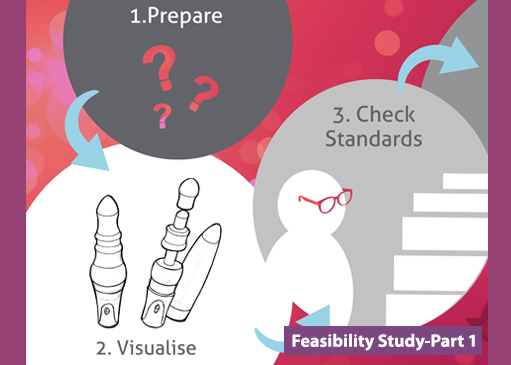
Is my product idea feasible? Part 1

feasibility-sated-cover

What is a feasibility study?

In product development, a feasibility study asks whether or not your project is do-able. It should be conducted at the outset of a project against the background context of the business, and it takes into account all factors likely to have an impact, including economic, technical, legal and scheduling aspects.

Will the project achieve the desired effect within the set budget and timeframe? Can you adequately fund the project? Do you have the technical resources to transform your project into reality or will you need to outsource? Will there be any legal considerations or conflicts that arise from your project? Can you achieve your goals within the specified deadlines?

These answers and many others allow business leaders to decide if there is enough potential for the project to succeed or that it is worth allocating resources towards pursuing it further.

1) Prepare – Where Do I Start?

To make the best use of a feasibility study, you should collect together all of the relevant information you have relating to the project. Each project will be different but the following should be considered:

– Costings and budget
– Material preferences
– Target market
– Anticipated life cycle of the product
– Aesthetics & Styling
– Pre-existing or problematic Intellectual Property (IP)
– Funding and investment
– Technological requirements
– Legal requirements and standards
– Milestones and deadlines

2) Visualising Your Product

In most cases, visual images of a product are one of the quickest ways to get feedback from interested parties, collaborators, stakeholders, and users. Most projects will require some form of visual material to communicate ideas effectively. A picture tells a thousand words and Sated Design can help you to tell the best story.

Mood boards, hand-drawn sketches, shaded industrial design illustrations and 3D CGI renders are all examples of visual presentation techniques. The number of images and the techniques used to communicate ideas will vary dependant on time, budget, intended use, and the complexity of the subject.

Coming up in Part 2 – Understanding Standards, Manufacture and Assembly, and Running the Numbers – Preliminary Costings.

Sharing

FacebooktwitterredditpinterestlinkedinmailFacebooktwitterredditpinterestlinkedinmail

Adult toys using new materials

New materials for Adult Toys

We have seen all sorts of  new materials that are used with adult sex toys. Glass, wood and stone are some of the recent favourites but we never expected to see a faux wood effect. The jury is out on this one for us because we see innovation being more than a cosmetic wrapping.

Sex Toy Material Selection

It is always important to select the correct material for a product or certain parts of a product. Selecting materials to be used in sex toys are no exception. The material is key to creating the sex toy experience from glass toys that are smooth and rigid to silicone sex toys that are flexible and can be textured. Further developments in silicone materials feature the ability to conduct low levels of electricity which create a very unique experience. All materials used in sex toys need to be safe to use with the skin and at Sated Design our extensive knowledge and experience with material will ensure we can help you to create an innovative, exciting and safe product.

Sharing

FacebooktwitterredditpinterestlinkedinmailFacebooktwitterredditpinterestlinkedinmail